
Smartlife
Leveraging model and data-driven digital twins for smart asset management and lifetime optimization of offshore windfarms
Introduction
2 partners
Coordinator: 24SEA
Project type: Fundamental research
Start Data: 1/11/2023
Duration: 2 years
Total Budget: €1.186.997
Funded by the Energy Transition Fund (ETF)

Project Context
There are currently 399 wind turbines installed in the Belgian part of North Sea. The oldest wind turbines are already operational for about 15 years. The lifetime of these offshore windfarms is driven by the fatigue life of their foundations, simply because they are the major structural component that cannot be replaced. Once the fatigue life of the foundation is consumed, the structure is no longer suitable to support the wind turbine and production will halt.
Project Description
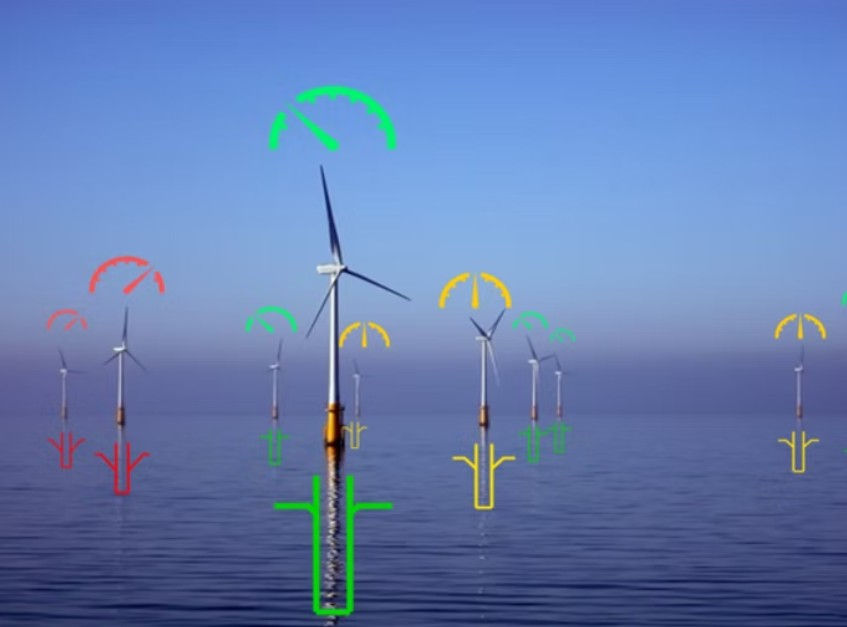
The project aims to develop tools for further optimising the operation and maintenance of the offshore wind farms, while guaranteeing structural reliability and increasing the chances of extending the life of the offshore wind infrastructure in the Belgian North Sea. In this way, this project can directly contribute to the federal policy on the energy transition and energy supply security. The project wants to use advanced physics-based and data-based so-called "digital twins".
Project Objective
The project aims to generate unique know-how and innovative data handling solutions validated on real windfarm data. The project wants to leverage the use of the available sensor data and windfarm operational data combined with advanced physics-based and data-driven digital twin tools for optimising the operation and maintenance of the offshore wind farms, while guaranteeing the structural reliability, and increasing the likelihood of lifetime extension of the offshore wind infrastructure in the Belgium North Sea. In doing so it will contribute to the security of energy supply, enhancing grid stability and increasing the likelihood of a future subsidy-free offshore wind-development in the North Sea.
To meet this global objective, the following targets are set:
The developed tools must be able to estimate the fatigue lifetime of every weld on every turbine within the windfarm.
The developed tools must also allow to run multiple scenarios, based on changing the original design assumptions, and evaluate their impact on lifetime.
The developed tool must be able to consider the original design assumptions, the real-time monitoring data and the latest inspection data
The tools must empower windfarm operators to make informed decisions themselves for optimizing their O&M strategies based on their impact on the lifetime of their assets.
More info and related articles can be found on Researchgate
The Smartlife project is financially supported by FPS Economy, as a fundamental research project within the Energy Transition Fund (project call 2022- duration of project 01.11.23 – 30.04.2026)
Key Results
The SmartLife project has successfully developed and validated an integrated framework for structural health monitoring (SHM) and lifetime assessment of offshore wind turbine foundations in the Belgian North Sea. The results demonstrate a significant step forward in enabling data-driven, fleet-wide asset management and lifetime optimization.
A major achievement of the project is the deployment of a scalable monitoring data infrastructure, combining an Edge–Fog–Cloud architecture to enable automated collection, storage, and processing of large volumes of monitoring data across entire wind farms. This is complemented by a centralized metadatabase that integrates design, inspection, and operational data into a unified and traceable environment.
The project also introduced a standardized framework for operational condition classification, allowing consistent identification of turbine states and enabling improved fatigue and lifetime assessments across different wind farms.
On the modelling side, SmartLife delivered both physics-based and data-driven digital twins. Physics-based models were validated using real offshore data and deployed at full wind farm scale. In parallel, data-driven approaches—including Artificial Neural Networks and Bayesian Neural Networks—enable accurate fleet-wide estimation of fatigue loads, while also providing uncertainty quantification to support risk-informed decision-making.
A key innovation lies in the development of advanced machine learning methodologies. These include self-supervised learning techniques capable of inferring operational states and fatigue directly from vibration data, even without reliance on SCADA systems, as well as fleet-wide anomaly detection methods and graph-based models that capture turbine-to-turbine interactions and wake effects at wind farm level.
The project also demonstrated highly accurate fatigue prediction using minimal sensing, showing that reliable results can be achieved with simplified sensor setups. This significantly reduces monitoring complexity and cost while maintaining high predictive performance.
In addition, SmartLife developed multiple data-driven methodologies for estimating remaining useful life (RUL). These approaches—ranging from statistical techniques to machine learning models—were shown to deliver consistent lifetime predictions, providing a robust basis for asset management and life extension decisions.
Finally, proof-of-concept decision-support tools were developed to translate the technical results into actionable insights. These include fleet-wide fatigue and lifetime reporting based on damage-equivalent loads, scenario analysis frameworks to evaluate operational strategies, and benchmarking tools that identify lifetime overconsumption due to non-optimal turbine operation.
Overall, SmartLife demonstrates the feasibility and industrial relevance of combining monitoring data, digital twins, and machine learning into a unified framework. The results enable improved understanding of fatigue drivers, support evidence-based lifetime extension, and provide actionable insights for optimizing offshore wind farm operation and maintenance.


